Sunday, March 31, 2019

Limits to Growth


                                              Comments due by  April 7, 2019

The following is from Limits to Growth published by The Club of Rome 47 years ago. This short book was the first computerised model to make projections about many of the issues that have become central matters in Environmental/Ecological Economics. It is interesting to note that although we have been aware of the severity of the possible ecological degradation that we are facing one can argue that we have not done much about it. Why?

                                                         ******************************
 “I do not wish to seem overdramatic, but I can only conclude from the Information that Is available to me as Secretary General, that the Members of the United Nations have perhaps ten years left In which to subordinate their ancient quarrels and launch a global partnership to curb the arms race, to improve the human environment, to defuse the population explosion, and to supply the required momentum to development efforts. If such a global partnership Is not forged within the next decade, then I very much fear that the problems I have mentioned will have reached such staggering proportions that they will be beyond our capacity to control.” U THANT, 1969
 The problems U Thant mentions : the arms race, environmental deterioration, the population explosion, and economic stagnation-are often cited as the central, long-term problems of modern man. Many people believe that the future course of human society, perhaps even the survival of human society, depends on the speed and effectiveness with which the world responds to these issues. And yet only a small fraction of the world's population is actively concerned with understanding these problems or seeking their solutions.
Every person in the world faces a series of pressures and problems that require his attention and action. These problems affect him at many different levels. He may spend much of his time trying to find tomorrow's food for himself and his family. He may be concerned about personal power or the power of the nation in which he lives. He may worry about a world war during his lifetime, or a war next week with a rival clan in his neighborhood.  
 The majority of the world's people are concerned with matters that affect only family or friends over a short period of time. Others look farther ahead in time or over a larger area-a city or a nation. Only a very few people have a global perspective that extends far into the future. Fields can be destroyed by an international war. Local officials' plans can be overturned by a national policy. A country's economic development can be thwarted by a lack of world demand for its products. Indeed there is increasing concern today that most personal and national objectives may ultimately be frustrated by long-term, global trends such as those mentioned by U Thant. Are the implications of these global trends actually so threatening that their resolution should take precedence over local, short-term concerns ? Is it true, as U Thant suggested, that there remains less than a decade to bring these trends under control ? If they are not brought under control, what will the consequences be ? What methods does mankind have for solving global problems, and what will be the results and the costs of employing each of them? These are the questions that we have been investigating in the first phase of The Club of Rome's Project on the Predicament of Mankind.
Every person approaches his problems, wherever they occur on the space-time graph, with the help of models. A model is simply an ordered set of assumptions about a complex system. It is an attempt to understand some aspect of the infinitely varied world by selecting from perceptions and past experience a set of general observations applicable to the problem at hand. A farmer uses a mental model of his land, his assets, market prospects, and past weather conditions to decide which crops to plant each year. A surveyor constructs a physical model-a map-to help in planning a road. An economist uses mathematical models to understand and predict the flow of international trade. Decision-makers at every level unconsciously use mental models to choose among policies that will shape our future world. These mental models are, of necessity, very simple when compared with the reality from which they are abstracted. The human brain, remarkable as it is, can only keep track of a limited number of the complicated, simultaneous interactions that determine the nature of the real world. We, too, have used a model. Ours is a formal, written model of the world.• It constitutes a preliminary attempt to improve our mental models of long-term, global problems by combining the large amount of information that is already in human minds and in written records with the new information-processing tools that mankind's increasing knowledge has produced-the scientific method, systems analysis, and the modern computer. Our world model was built specifically to investigate five major trends of global concern-accelerating industrialization, rapid population growth, widespread malnutrition, depletion of nonrenewable resources, and a deteriorating environment. These trends are all interconnected in many ways, and their development is measured in decades or centuries, rather than in months or years. With the model we are seeking to understand the causes of these trends, their interrelationships, and their implications as much as one hundred years in the future. The model we have constructed is, like every other model, imperfect, oversimplified, and unfinished. We are well aware of its shortcomings, but we believe that it is the most useful model now available for dealing with problems far out on the space-time graph. To our knowledge it is the only formal model in existence that is truly global in scope, that has a time horizon longer than thirty years, and that includes important variables such as population, food production, and pollution, not as independent entities, but as dynamically interacting elements, as they are in the real world. Since ours is a formal, or mathematical, model it also has two important advantages over mental models. First, every assumption we make is written in a precise form so that it is open to inspection and criticism by all. Second, after the assumptions have been scrutinized, discussed, and revised to agree with our best current knowledge, their implications for the future behavior of the world system can be traced without error by a computer, no matter how complicated they become. We feel that the advantages listed above make this model unique among all mathematical and mental world models available to us today. But there is no reason to be satisfied with it in its present form. We intend to alter, expand, and improve it as our own knowledge and the world data base gradually improve. In spite of the preliminary state of our work, we believe it is important to publish the model and our findings now. Decisions are being made every day, in every part of the world, that will affect the physical, economic, and social conditions of the world system for decades to come. These decisions cannot wait for perfect models and total understanding. They will be made on the basis of some model, mental or written, in any case. We feel that the model described here is already sufficiently developed to be of some use to decision-makers. Furthermore, the basic behavior modes we have already observed in this model appear to be so fundamental and general that we do not expect our broad conclusions to be substantially altered by further revisions.  It is not the purpose of this book to give a complete, scientific description of all the data and mathematical equations included in the world model. Such a description can be found in the final technical report of our project. Rather, in The Limits to Growth we summarize the main features of the model and our findings in a brief, nontechnical way. The emphasis is meant to be not on the equations or the intricacies of the model, but on what it tells us about the world. We have used a computer as a tool to aid our own understanding of the causes and consequences of the accelerating trends that characterize the modern world, but familiarity with computers is by no means necessary to comprehend or to discuss our conclusions. The implications of those accelerating trends raise issues that go far beyond the proper domain of a purely scientific document. They must be debated by a wider community than that of scientists alone. Our purpose here is to open that debate. The following conclusions have emerged from our work so far. We are by no means the first group to have stated them. For the past several decades, people who have looked at the world with a global, long-term perspective have reached similar conclusions. Nevertheless, the vast majority of policymakers seems to be actively pursuing goals that are inconsistent with these results.
Our conclusions are: 1. If the present growth trends in world population, industrialization, pollution, food production, and resource depletion continue unchanged, the limits to growth on this planet will be reached sometime within the next one hundred years. The most probable result will be a rather sudden and uncontrollable decline in both population and industrial capacity.2. It is possible to alter these growth trends and to establish a condition of ecological and economic stability that is sustainable far into the future. The state of global equilibrium could be designed so that the basic material needs of each person on earth are satisfied and each person has an equal opportunity to realize his individual human potential. 3. If the world's people decide to strive for this second outcome rather than the first, the sooner they begin working to attain it, the greater will be their chances of success. These conclusions are so far-reaching and raise so many questions for further study that we are quite frankly overwhelmed by the enormity of the job that must be done. We hope that this book will serve to interest other people, in many fields of study and in many countries of the world, to raise the space and time horizons of their concerns and to join us in understanding and preparing for a period of great transition the transition from growth to global equilibrium.

Saturday, March 16, 2019

Stopping CO2 emissions is not enough, they must be sucked out of the atmosphere also.


                                      Comments due  March 30, 2019

Three years ago the world pledged to keep global warming “well below” 2°C hotter than pre-industrial times. Climate scientists and campaigners purred. Politicians patted themselves on the back. Despite the Paris agreement’s ambiguities and some setbacks, including President Donald Trump’s decision to yank America out of the deal, the air of self-congratulation was still on show among those who gathered in Bonn for a follow-up summit.
Yet the most damaging thing about America’s renewed spasm of climate-change rejection may not be the effect on its own emissions, which could turn out to be negligible. It is the cover America has given other countries to avoid acknowledging the problems of the agreement America is abandoning.
The Paris agreement assumes, in effect, that the world will find ways to suck CO2 out of the air. That is because, in any realistic scenario, emissions cannot be cut fast enough to keep the total stock of greenhouse gases sufficiently small to limit the rise in temperature successfully. But there is barely any public discussion of how to bring about the extra “negative emissions” needed to reduce the stock of CO2 (and even less about the more radical idea of lowering the temperature by blocking out sunlight). Unless that changes, the promise of limiting the harm of climate change is almost certain to be broken.
Don’t be so positive
Fully 101 of the 116 models the Intergovernmental Panel on Climate Change uses to chart what lies ahead assume that carbon will be taken out of the air in order for the world to have a good chance of meeting the 2°C target. The total amount of CO2 to be soaked up by 2100 could be a staggering 810bn tonnes, as much as the world’s economy produces in 20 years at today’s rate . Putting in place carbon-removal schemes of this magnitude would be an epic endeavour even if tried-and-tested techniques existed.
They do not. A few power stations and industrial facilities capture CO2 that would otherwise end up in the air and store it away underground, a practice known as carbon capture and storage. But this long-touted approach to cutting emissions still operates on only a very small scale, dealing with just a few tens of millions of tonnes of CO2 a year. And such schemes merely lower emissions; they do not reverse them.
What might? One option is to plant more forests (which act as a carbon sink) or to replace the deep-ploughing of fields with shallow tillage (which helps soils absorb and retain more CO2). Another is to apply carbon capture and storage to biomass-burning power plants, stashing the carbon sucked up by crops or trees burnt as fuel. Fancier ideas exist. Carbon could be seized directly from the air, using chemical filters, and stored. Or minerals could be ground up and sowed over land or sea, accelerating from aeons to years the natural weathering process that binds them to CO2 to form carbonate rocks.
Whether any of these technologies can do the job in time is unknown. All of them are very expensive and none is proven at scale. Persuading Earth’s swelling population to plant an India’s worth of new trees or crops to produce energy, as the climate simulations require, looks highly improbable. Changing agricultural practices would be cheaper, but scientists doubt that this would suck up enough CO2 even to offset the greenhouse gases released by farming. Direct air capture and enhanced weathering use less land, but both are costlier. Though renewable energy could profitably generate a fair share of the world’s electricity, nobody knows how to get rich simply by removing greenhouse gases.
When the need is great, the science is nascent and commercial incentives are missing, the task falls to government and private foundations. But they are falling short.
More science would serve as a collective insurance policy against a grave threat. However, this year Britain became just the first country to devote cash to such projects; America is eyeing grants, too, despite Mr Trump. Britain’s one-off £8.6m ($11.3m) is footling. Roughly $15bn a year goes to research into all low-carbon technologies; that pot needs to increase, and more of it should be channelled to extracting carbon.

Another form of climate denial
A big market for CO2 would provide an extra incentive to mine it from the atmosphere. But its uses are still limited. If regulators forced industries that cannot convert to electricity, such as aviation, to use synthetic fuels rather than fossil ones, demand for the CO2that is the raw material for those fuels could increase greatly. The industries, though, would resist.
If the market will not provide an incentive, governments could. The case for a proper price on carbon (this paper has favoured a tax) is strong. Its absence is one of the reasons carbon capture and storage has not taken off as a way of reducing emissions from fossil-fuel plants; the kit needed can double the price of electricity. Yet, setting a price high enough to encourage negative emissions would asphyxiate the economy.
Subsidies are another option. Without them, renewables would have taken longer to compete with fossil fuels. But they are wasteful. Germany has lavished $1trn on low-carbon electricity, and even then still depends on fossil fuels for over half its power. Still, governments could offer a reward for every tonne of CO2 that is extracted and stored. In theory such a bounty should be paid from a fund bankrolled by countries according to their cumulative historical emissions (top comes America followed by Europe, with China rapidly closing the gap). In practice no mechanism exists to get them to cough up.
Indeed, facing the shortcomings of Paris is beyond most governments. Under Mr Trump, America is not prepared to reduce the flow of emissions, let alone the stock. But the problem would not magically be solved even if America returned to the fold. Many rich countries say they are already doing their bit by cutting emissions more steeply than developing countries. In fact, taking carbon dioxide from the atmosphere is not an alternative to belching out less greenhouse gas. It is necessary in its own right. Unless policymakers take negative emissions seriously, the promises of Paris will ring ever more hollow.
This article appeared in the Leaders section of the print edition under the headline "What they don’t tell you"

Saturday, March 9, 2019

A Brief Intro to The Kuznets Curve


                                                    Comments due by March 16, 2019


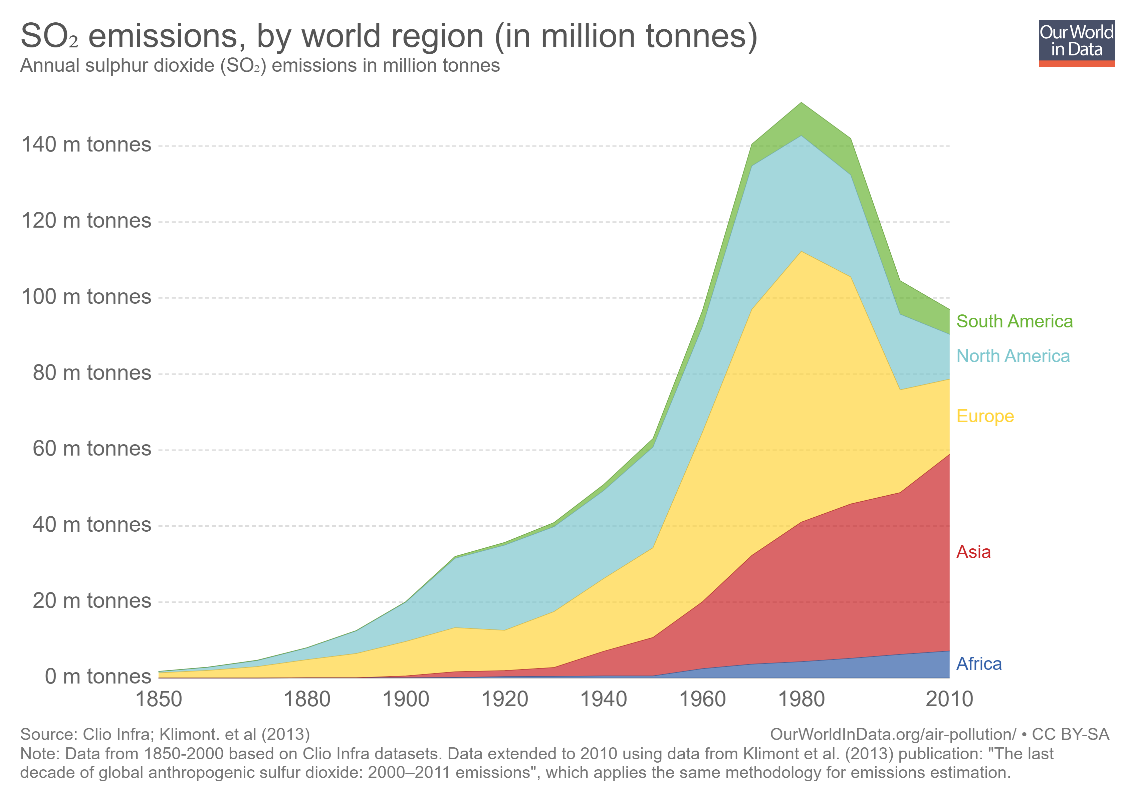
The environmental Kuznets curve (EKC) is a hypothesized relationship between various indicators of environmental degradation and income per capita. In the early stages of economic growth degradation and pollution increase, but beyond some level of income per capita, which will vary for different indicators, the trend reverses, so that at high income levels economic growth leads to environmental improvement. This implies that the environmental impact indicator is an inverted U-shaped function of income per capita.

An example of an estimated EKC is shown in Figure 1. The EKC is named for Kuznets (1955) who hypothesized that income inequality first rises and then falls as economic development proceeds.


Figure 1. Environmental Kuznets curve for sulfur emissions.  

 If the EKC hypothesis were true, then rather than being a threat to the environment, as claimed by the environmental movement and associated scientists in the past (e.g., Meadows, Meadows, Randers, & Behrens, 1972), economic growth would be the means to eventual environmental improvement. This change in thinking was already underway in the emerging idea of sustainable economic development promulgated by the World Commission on Environment and Development (1987) in Our Common Future. The possibility of achieving sustainability without a significant deviation from business as usual was an obviously enticing prospect for many––letting humankind “have our cake and eat it”.
Proponents of the EKC hypothesis argue that
at higher levels of development, structural change towards information-intensive industries and services, coupled with increased environmental awareness, enforcement of environmental regulations, better technology and higher environmental expenditures, result in leveling off and gradual decline of environmental degradation.

It is clear that emissions of many pollutants per unit of output have declined over time in developed countries with increasingly stringent environmental regulations and technical innovations. But the mix of residuals has shifted from sulfur and nitrogen oxides to carbon dioxide and solid waste so that aggregate waste is still high and per capita waste may not have declined.9 Economic activity is inevitably environmentally disruptive in some way. Satisfying the material needs of people requires the use and disturbance of energy flows and materials stocks. Therefore, an effort to reduce some environmental impacts may just aggravate other problems.

The evidence shows that the statistical analysis on which the environmental Kuznets curve is based is not robust. There is little evidence for a common inverted U-shaped pathway that countries follow as their income rises. There may be an inverted U-shaped relation between urban ambient concentrations of some pollutants and income though this should be tested with more rigorous time-series or panel data methods. It seems unlikely that the EKC is an adequate model of emissions or concentrations


Saturday, February 23, 2019

Green New Deal


                                                Comments due  March 9, 2019

I imagine that each of you has heard of and maybe has formed ideas about the Green New Deal. The following is the text as it was released by AOC. Since this post is a bit long and since we have an exam on March 1, 2019 I decided to treat this post as two separate assignments. That is why the due date is two weeks from now and not the customary one week. I expect to read about your views: do you think the plan is viable, do you think that we can afford it, do you think that it will make a meaningful difference if implemented. Speak your mind but as always what you say must be guided by facts.


If you prefer to read the slightly longer full text instead of the resolution then go to: http://filesforprogress.org/pdfs/Green_New_Deal.pdf

· We will begin work immediately on Green New Deal bills to put the nuts and bolts on the plan described in this resolution (important to say so someone else can’t claim this mantle).
 · This is a massive transformation of our society with clear goals and a timeline.
o The Green New Deal resolution a 10-year plan to mobilize every aspect of American society at a scale not seen since World War 2 to achieve net-zero greenhouse gas emissions and create economic prosperity for all. It will: § Move America to 100% clean and renewable energy § Create millions of family supporting-wage, union jobs § Ensure a just transition for all communities and workers to ensure economic security for people and communities that have historically relied on fossil fuel industries § Ensure justice and equity for frontline communities by prioritizing investment, training, climate and community resiliency, economic and environmental benefits in these communities. § Build on FDR’s second bill of rights by guaranteeing: · A job with a family-sustaining wage, family and medical leave, vacations, and retirement security · High-quality education, including higher education and trade schools · Clean air and water and access to nature · Healthy food · High-quality health care · Safe, affordable, adequate housing · Economic environment free of monopolies · Economic security for all who are unable or unwilling to work · There is no time to waste.
 o IPCC Report said global emissions must be cut by by 40-60% by 2030. US is 20% of total emissions. We must get to 0 by 2030 and lead the world in a global Green New Deal. · Americans love a challenge. This is our moonshot.
o When JFK said we’d go to the moon by the end of the decade, people said impossible.
o If Eisenhower wanted to build the interstate highway system today, people would ask how we’d pay for it.
o When FDR called on America to build 185,000 planes to fight World War 2, every business leader, CEO, and general laughed at him. At the time, the U.S. had produced 3,000 planes in the last year. By the end of the war, we produced 300,000 planes. That’s what we are capable of if we have real leadership · This is massive investment in our economy and society, not expenditure.
o We invested 40-50% of GDP into our economy during World War 2 and created the greatest middle class the US has seen. o The interstate highway system has returned more than $6 in economic productivity for every $1 it cost o This is massively expanding existing and building new industries at a rapid pace – growing our economy · The Green New Deal has momentum.
o 92 percent of Democrats and 64 percent of Republicans support the Green New Deal o Nearly every major Democratic Presidential contender say they back the Green New deal including: Elizabeth Warren, Cory Booker, Kamala Harris, Jeff Merkeley, Julian Castro, Kirsten Gillibrand, Bernie Sanders, Tulsi Gabbard, and Jay Inslee. o 45 House Reps and 330+ groups backed the original resolution for a select committee o Over 300 local and state politicians have called for a federal Green New Deal o New Resolution has 20 co-sponsors, about 30 groups
 Why 100% clean and renewable and not just 100% renewable? Are you saying we won’t transition off fossil fuels? Yes, we are calling for a full transition off fossil fuels and zero greenhouse gases. Anyone who has read the resolution sees that we spell this out through a plan that calls for eliminating greenhouse gas emissions from every sector of the economy. Simply banning fossil fuels immediately won’t build the new economy to replace it – this is the plan to build that new economy and spells out how to do it technically. We do this through a huge mobilization to create the renewable energy economy as fast as possible. We set a goal to get to net-zero, rather than zero emissions, in 10 years because we aren’t sure that we’ll be able to fully get rid of farting cows and airplanes that fast, but we think we can ramp up renewable manufacturing and power production, retrofit every building in America, build the smart grid, overhaul transportation and agriculture, plant lots of trees and restore our ecosystem to get to net-zero. Is nuclear a part of this? A Green New Deal is a massive investment in renewable energy production and would not include creating new nuclear plants. It’s unclear if we will be able to decommission every nuclear plant within 10 years, but the plan is to transition off of nuclear and all fossil fuels as soon as possible. No one has put the full 10-year plan together yet, and if it is possible to get to fully 100% renewable in 10 years, we will do that. Does this include a carbon tax? The Green New Deal is a massive investment in the production of renewable energy industries and infrastructure. We cannot simply tax gas and expect workers to figure out another way to get to work unless we’ve first created a better, more affordable option. So we’re not ruling a carbon tax out, but a carbon tax would be a tiny part of a Green New Deal in the face of the gigantic expansion of our productive economy and would have to be preceded by first creating the solutions necessary so that workers and working class communities are not affected. While a carbon tax may be a part of the Green New Deal, it misses the point and would be off the table unless we create the clean, affordable options first. Does this include cap and trade? The Green New Deal is about creating the renewable energy economy through a massive investment in our society and economy. Cap and trade assumes the existing market will solve this problem for us, and that’s simply not true. While cap and trade may be a tiny part of the larger Green New Deal plan to mobilize our economy, any cap and trade legislation will pale in comparison to the size of the mobilization and must recognize that existing legislation can incentivize companies to create toxic hotspots in frontline communities, so anything here must ensure that frontline communities are prioritized. Does a GND ban all new fossil fuel infrastructure or nuclear power plants? The Green New Deal makes new fossil fuel infrastructure or nuclear plants unnecessary. This is a massive mobilization of all our resources into renewable energies. It would simply not make sense to build new fossil fuel infrastructure because we will be creating a plan to reorient our entire economy to work off renewable energy. Simply banning fossil fuels and nuclear plants immediately won’t build the new economy to replace it – this is the plan to build that new economy and spells out how to do it technically. Are you for CCUS? We believe the right way to capture carbon is to plant trees and restore our natural ecosystems. CCUS technology to date has not proven effective. How will you pay for it? The same way we paid for the New Deal, the 2008 bank bailout and extended quantitative easing programs. The same way we paid for World War II and all our current wars. The Federal Reserve can extend credit to power these projects and investments and new public banks can be created to extend credit. There is also space for the government to take an equity stake in projects to get a return on investment. At the end of the day, this is an investment in our economy that should grow our wealth as a nation, so the question isn’t how will we pay for it, but what will we do with our new shared prosperity. Why do we need a sweeping Green New Deal investment program? Why can’t we just rely on regulations and taxes and the private sector to invest alone such as a carbon tax or a ban on fossil fuels? · The level of investment required is massive. Even if every billionaire and company came together and were willing to pour all the resources at their disposal into this investment, the aggregate value of the investments they could make would not be sufficient.
· The speed of investment required will be massive. Even if all the billionaires and companies could make the investments required, they would not be able to pull together a coordinated response in the narrow window of time required to jump-start major new projects and major new economic sectors. Also, private companies are wary of making massive investments in unproven research and technologies; the government, however, has the time horizon to be able to patiently make investments in new tech and R&D, without necessarily having a commercial outcome or application in mind at the time the investment is made. Major examples of government investments in “new” tech that subsequently spurred a boom in the private section include DARPA projects, the creation of the internet - and, perhaps most recently, the government’s investment in Tesla.
 · Simply put, we don’t need to just stop doing some things we are doing (like using fossil fuels for energy needs); we also need to start doing new things (like overhauling whole industries or retrofitting all buildings to be energy efficient). Starting to do new things requires some upfront investment. In the same way that a company that is trying to change how it does business may need to make big upfront capital investments today in order to reap future benefits (for e.g., building a new factory to increase production or buying new hardware and software to totally modernize its IT system), a country that is trying to change how its economy works will need to make big investments today to jump-start and develop new projects and sectors to power the new economy.
 · Merely incentivizing the private sector doesn’t work - e.g. the tax incentives and subsidies given to wind and solar projects have been a valuable spur to growth in the US renewables industry but, even with such investment promotion subsidies, the present level of such projects is simply inadequate to transition to a fully greenhouse gas neutral economy as quickly as needed. · Once again, we’re not saying that there isn’t a role for private sector investments; we’re just saying that the level of investment required will need every actor to pitch in and that the government is best placed to be the prime driver.
Resolution Summary
 · Created in consultation with multiple groups from environmental community, environmental justice community, and labor community
· 5 goals in 10 years:
                                      o Net-zero greenhouse gas emissions through a fair and just transition for all communities and workers
                                      o Create millions of high-wage jobs and ensure prosperity and economic security for all
                                      o Invest in infrastructure and industry to sustainably meet the challenges of the 21st century
                                      o Clean air and water, climate and community resiliency, healthy food, access to nature, and a sustainable environment for all
                                      o Promote justice and equity by stopping current, preventing future, and repairing historic oppression of frontline and vulnerable communities
· National mobilization our economy through 14 infrastructure and industrial projects. Every project strives to remove greenhouse gas emissions and pollution from every sector of our economy:
           1   Build infrastructure to create resiliency against climate change-related disasters
          2    Repair and upgrade U.S. infrastructure. ASCE estimates this is $4.6 trillion at minimum.
          3   Meet 100% of power demand through clean and renewable energy sources
          4   Build energy-efficient, distributed smart grids and ensure affordable access to electricity
          5   Upgrade or replace every building in US for state-of-the-art energy efficiency
          6   Massively expand clean manufacturing (like solar panel factories, wind turbine factories, battery and storage manufacturing, energy efficient manufacturing components) and remove pollution and greenhouse gas emissions from manufacturing
           7   Work with farmers and ranchers to create a sustainable, pollution and greenhouse gas free, food system that ensures universal access to healthy food and expands independent family farming
          8   Totally overhaul transportation by massively expanding electric vehicle manufacturing, build charging stations everywhere, build out high speed rail at a scale where air travel stops becoming necessary, create affordable public transit available to all, with goal to replace every combustion-engine vehicle
           9   Mitigate long-term health effects of climate change and pollution
         10  Remove greenhouse gases from our atmosphere and pollution through afforestation, preservation, and other methods of restoring our natural ecosystems
          11  Restore all our damaged and threatened ecosystems
          12  Clean up all the existing hazardous waste sites and abandoned sites
          13  Identify new emission sources and create solutions to eliminate those emissions
          14  Make the US the leader in addressing climate change and share our technology, expertise and products with the rest of the world to bring about a global Green New Deal
· Social and economic justice and security through 15 requirements:
o Massive federal investments and assistance to organizations and businesses participating in the green new deal and ensuring the public gets a return on that investment
o Ensure the environmental and social costs of emissions are taken into account
o Provide job training and education to all
o Invest in R&D of new clean and renewable energy technologies
 o Doing direct investments in frontline and deindustrialized communities that would otherwise be hurt by the transition to prioritize economic benefits there
o Use democratic and participatory processes led by frontline and vulnerable communities to implement GND projects locally
o Ensure that all GND jobs are union jobs that pay prevailing wages and hire local
o Guarantee a job with family-sustaining wages
o Protect right of all workers to unionize and organize
o Strengthen and enforce labor, workplace health and safety, antidiscrimination, and wage and hour standards
o Enact and enforce trade rules to stop the transfer of jobs and pollution overseas and grow domestic manufacturing
o Ensure public lands, waters, and oceans are protected and eminent domain is not abused
o Obtain free, prior, and informed consent of Indigenous peoples
o Ensure an economic environment free of monopolies and unfair competition
o Provide high-quality health care, housing, economic security, and clean air, clean water, healthy food, and nature to all

Saturday, February 16, 2019

Earth Overshoot Day: Is it a good measure?


                                        Comments due by February 23, 2019
Experts widely agree that human activities are harming the global environment. Since the Industrial Revolution, the world economy has grown dramatically. Overall this is a success story, since rising incomes have lifted millions of people out of poverty. But it has been fueled by population growth and increasing consumption of natural resources.
Rising demand to meet the needs of more than 7 billion people has transformed land use and generated unprecedented levels of pollution, affecting biodiversity, forests, wetlands, water bodies, soils and air quality.
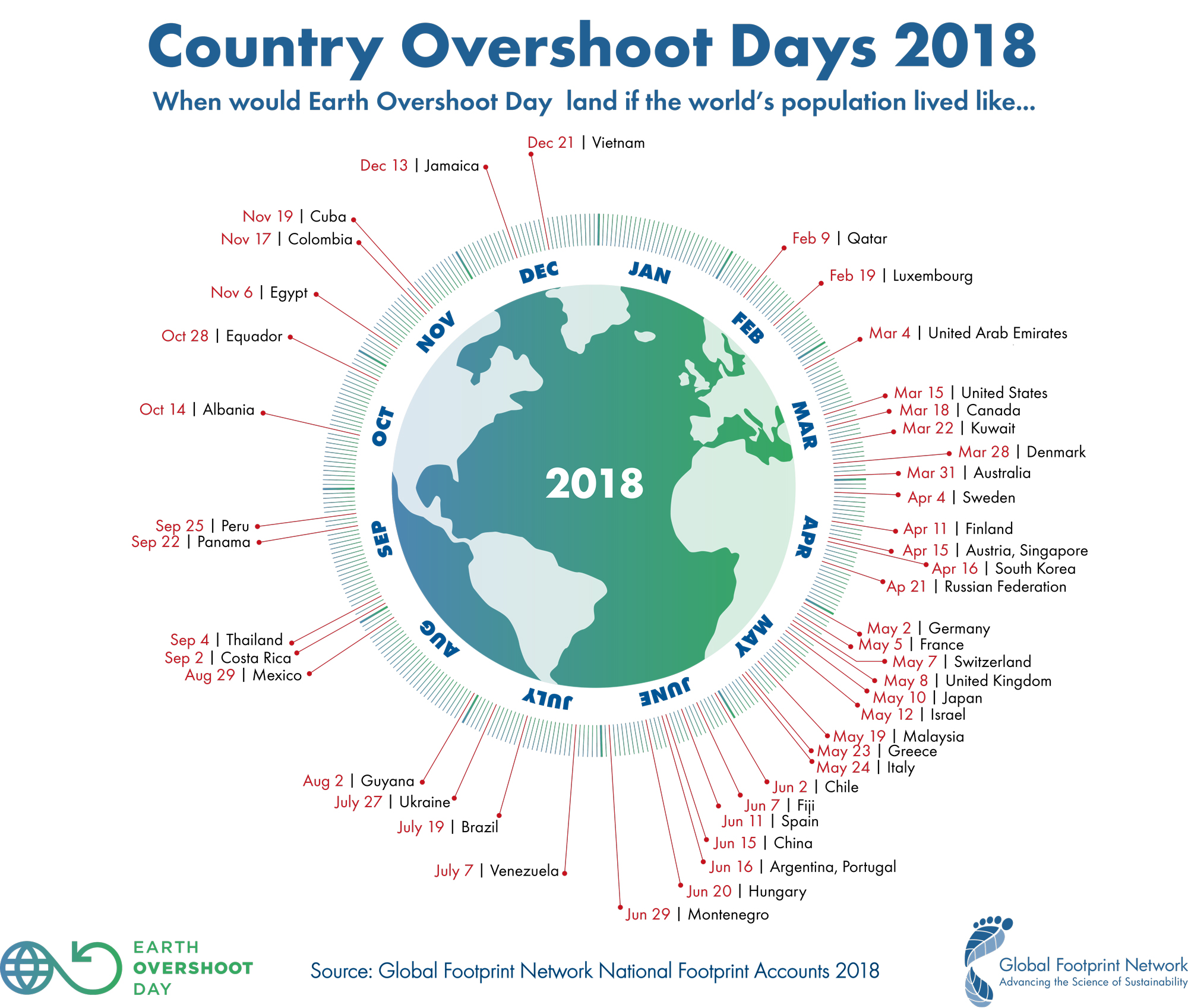
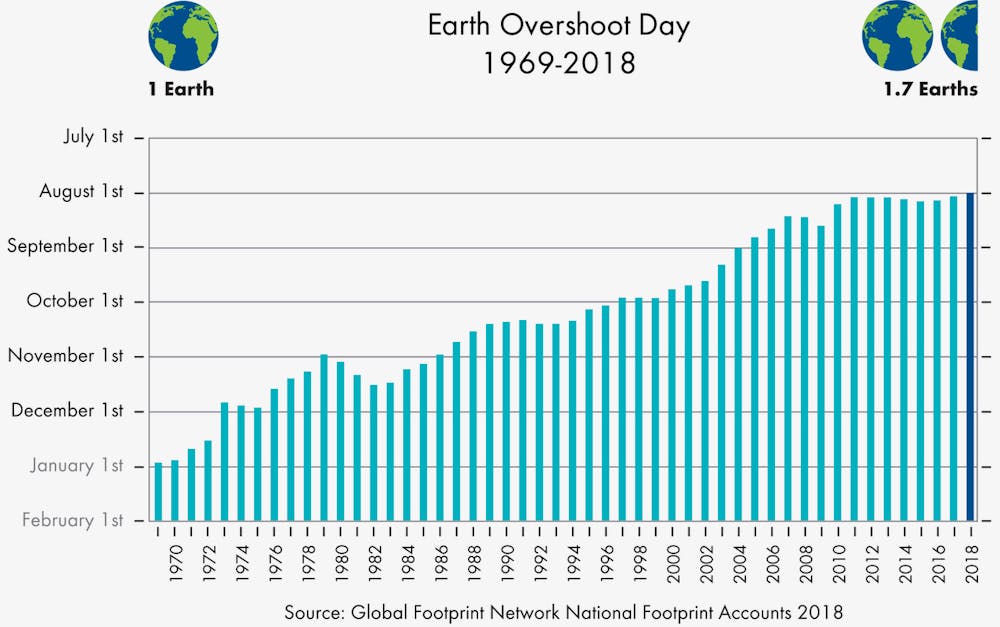
On Aug. 1, humans will have consumed more natural resources in 2018 than the Earth can regenerate this year, according to the California-based Global Footprint Network. This environmental nonprofit calculates the annual arrival of Earth Overshoot Day – the date when humanity’s demands on nature exceed what the network’s analysts estimate the Earth can regenerate over the entire year. Aug. 1 is the earliest date since ecological overshoot began in the early 1970s.
Aug. 1 is the earliest arrival of Earth Overshoot Day since humans started overusing the planet’s resources in the 1970s.Global Footprint NetworkCC BY-SA
As an ecological economist and scholar of sustainability, I am particularly interested in metrics and indicators that can help us understand human uses of Earth’s ecosystems. Better measurements of the impacts of human activities can help identify ways to sustain both human well-being and natural resources.
Earth Overshoot Day is a compelling concept and has raised awareness of the growing impact of human activities on the planet. Unfortunately, the methodology used to calculate it and the ecological footprint on which it is based is conceptually flawed and practically unusable in any science or policy context. In my view, the ecological footprint ultimately does not measure overuse of natural resources – and it may very well underestimate it.
Rising demands, finite resources
The Global Footprint Network estimates when Earth Overshoot Day will arrive based on its National Footprint Accounts. These include extensive data sets that the organization uses to calculate two overarching indicators:
·         The ecological footprint, perhaps the most commonly used metric of the environmental impacts of human resource use. Each country’s ecological footprint is an estimate of the biological resources required to meet its population’s consumption demands and absorb its carbon emissions.
·         National biocapacity, which is an estimate of how well each country’s ecosystems can produce the natural resources consumed by humans and absorb the waste and pollution that humans generate.
Both of these measures are expressed in global hectares. One hectare is equal to 10,000 square meters, or about 2.47 acres.
Going into overshoot
To estimate when Earth Overshoot Day will arrive, the Global Footprint Network calculates the number of days in a given year for which Earth has enough biocapacity to provide for humans’ total ecological footprint. The rest of the year represents “global overshoot.”
When the footprint of consumption worldwide exceeds biocapacity, the authors assert that humans are exceeding the regenerative capacity of Earth’s ecosystems. This year, they estimate that humans are using natural resources 1.7 times faster than ecosystems can regenerate – or, put another way, consuming 1.7 Earths.
As an example, the ecological footprint for France is 4.7 global hectares per person, and global biocapacity is 1.7 hectares per person. Therefore, it would take (4.7/ 1.7 =) 2.8 Earths if everyone lived like the French.
France’s Overshoot Day would be estimated as (365 x (1.7/ 4.7)) = 130, or the 130th day of the year, which is May 5 based on 2014 data. The United States reached overshoot even earlier, on March 1However, there are some fundamental and misleading shortcomings in these calculations. In a 2013 paper, six authors from academia, The Nature Conservancy and the California-based Breakthrough Instituteanalyzed how the Ecological Footprint falls short. In their view, it primarily measures humans’ carbon footprint but does not address other key impacts.
To calculate ecological footprints, the Global Footprint Network estimates the supply and demand of renewable biological resources across six land use types: forests, fishing grounds, croplands, grazing lands, developed lands and the area of forest required to offset human carbon emissions – that is, the carbon footprint. According to the network’s own analysis, each of these land use types is nearly in balance or in surplus, except for the carbon footprint.

The two key categories for producing food – cropland and grazing land – are defined in such a way that they can never be in deficit. And the analysis does not reflect environmental consequences of human use of these lands, such as soil erosion, nutrient runoff or overuse of water. It measures only land area.
For example, the ecological footprint for Indonesia is 1.61 global hectares per person, which is among the lowest 30 percent of all countries. But according to a 2014 study, Indonesia has the highest deforestation rate in the world.
Furthermore, the footprint calculation does not consider whether stocks of natural resources are decreasing or increasing as a result of human consumption. This question is critical for understanding ecological impacts.
These national ecological footprint calculations also conflate sustainability with self-sufficiency. They assume that every nation should produce all of the resources it consumes, even though it might be less expensive for countries to import some goods than to produce them at home.
As an example, the network lists Canada as an “ecological creditor” whose biocapacity exceeds its population’s ecological footprint. However, Canada is among the top 10 oil-producing countries in the world, and exports much of that oil for foreign consumption. Most of it goes to the United States, an “ecological debtor” that consumes more resources than it produces.
Thinking purely in terms of generic “resources,” everyone is better off when debtor countries can import resources from nations with supplies to spare. There are real and important environmental impacts associated with producing and consuming oil, but the network’s calculations do not address them. Nor do they reflect the decline in natural capital from extracting a nonrenewable resource.
Measuring sustainability
The Global Footprint Network asserts that “You can’t manage what you can’t measure,” but it may be impossible to create a single metric that can capture all human impacts on the environment. Earth Overshoot Day highlights unsustainable uses of natural resources, but we need scientifically robust ecological indicators to inform environmental policy, and a broader understanding of ecological risks.
Better measurements of sustainability should reflect changes in our supplies of natural capital, include estimates of uncertainty and incorporate multiple pathways to reducing carbon footprints. The best tool for measuring human impacts on the planet may be a dashboard of environmental indicators, not a footprint.


Saturday, February 9, 2019

Is NEPA Dead?


                                              Comments due by February 16, 2019


 Since 1970, the public has had a voice in major federal infrastructure projects. But the landmark environmental law that gives us that right is having its teeth pulled. The National Environmental Policy Act is the nation's oldest environmental law, widely known as the Magna Carta of green legislation. A blueprint for minimizing environmental impacts while ensuring compliance with federal laws like the Endangered Species Act, NEPA compels federal agencies to consider potential consequences of any "major" project they take on.
When President Richard Nixon signed NEPA into law in 1970, he said it would help "America pays its debt to the past by reclaiming the purity of its air, its waters, and our living environment." NEPA was forged in response to decades of preventable environmental disasters: highway growth that bulldozed entire neighborhoods in the 1950s, an oil spill in California that came from offshore drilling, and the infamous Cuyahoga River fire, among others. There are few hard statistics on the efficiency of NEPA, but the law has demonstrably improved countless infrastructure projects, saving trees, wetlands, and— yes—money throughout the United States for the last 50 years. Now, of course, the Trump administration is trying to gut the law. At six pages and one line, the law isn't long or complex; it serves more as an ingredient list than as a full recipe. It mostly just orders federal agencies to find, minimize, and report impacts of federal projects. It also establishes the Council on Environmental Quality, a group that's central in President Donald Trump's plan to defang the law. Under the purview of the White House, the CEQ is NEPA's executive operative, regulating how NEPA is implemented by and between federal agencies. Since the CEQ issued its regulation on NEPA compliance in 1978, the council has only made two amendments to its text—once to change its mailing address, and once to eliminate "worst-case" analysis from the review process (the latter change happened under President Ronald Reagan, though the withdrawal of language was apolitical, more due to confusing wording in the process that made it difficult to implement than to anything else). Over the past year, the CEQ, under the guidance of the Trump administration, has been working not just to amend NEPA, but to rewrite it altogether. As long as Trump has been president, the top spot at the CEQ has been vacant—until three weeks ago, when the Senate confirmed Mary Neumayr as chairwoman of the council. (Absent of an official chair, Neumayr had already been in the top spot at the CEQ since March of 2017.) Though her views on climate are not as extreme as those of the previous nominee—Neumayr at least says she believes in climate change—she is squarely conservative in her views on government regulation. As ThinkProgress points out, Neumayr once wrote a paper for the conservative Federalist Society criticizing government regulations, including environmental laws, for their alleged "criminalization" of corporate activity. Having served in various energy and environmental federal counsel positions spanning the George W. Bush and Barack Obama presidencies, she looks a lot like an establishment conservative. Most important, she has pledged to carry out the agenda of the Trump administration. As chief of staff at the CEQ, Neumayr had already begun to do so. In 2017, she oversaw the withdrawal of Obama-era guidance requiring agencies to include greenhouse gases and climate change in their NEPA reviews. In June of last year, the CEQ put out a notice that it would be amending NEPA, and opened the rule for public comment. The notice poses 20 questions to the public, asking generally about whether parts of NEPA could be "updated" or "clarified," and whether the process could be made more "timely" or "efficient." While the CEQ hasn't put out any legislation yet, the tenor and thrust of these questions suggest that Trump's goal is to slash NEPA by restricting its usage and narrowing its purview. "There are two strands of attack on NEPA," says Pat Gallagher, legal director at the Sierra Club.* "What they're trying to do via regulation [is] to weaken the actual triggers for when they have to act on NEPA." Part of that strategy requires massaging the definition of what constitutes a "major federal project," which refers to projects big enough to warrant an environmental review in the first place, and expanding the list of "categorical exclusions," a list of actions that an agency may take that have been predetermined not to warrant a NEPA review.
 As an example, Gallagher says that an agency may stipulate that up to 10,000 acres of post-fire logging would be categorically excluded from undergoing an environmental review. "And that's a big problem. They're basically going to try to take big whole classes of actions and just remove them from NEPA," he says. That's not just a regulatory problem; it's a problem for democracy as well. A crucial part of NEPA is its requirement that every project undergoing the environmental review process be open to public comment. Through this mechanism, communities can drastically change the form of a project through the public comment process: They can suggest alternatives that may not only be beneficial to their local environment, but also make a project cheaper and more efficient. Public comment on a highway project in Colorado, for instance, helped minimize tree removal and dust due to construction, while adding bike lanes. The community-sourced alternative to the highway project ended up costing less than the original plan. Exempting entire categories of projects from NEPA, then, would "gut the statute. It removes the public from any review," Gallagher laments. The other strand of attack on NEPA is to place arbitrary restrictions on how long the environmental review process can take. Right now, a typical review will take three to five years; Trump's goal is to cut it to two years. He also wants to shorten the statute of limitations for claims drastically, from six years to 150 days. Ironically, this approach could make the review process even longer. "My prediction about that strand is that it will result in more litigation and more successes by the [non-governmental organization] community," Gallagher says, "because haste makes waste." As for trying to shorten the statute of limitations, Gallagher adds, "we're not that stupid. We know about statutes of limitations, so if we see a bad NEPA document, and we feel like it's grounds for litigation, we're going to pursue it." Is there a way to shorten the NEPA's often lengthy review process without sacrificing basic environmental protections? California's version of NEPA, the California Environmental Quality Act, despite being more stringent, has a one-year time limit on its review process. A NEPA review typically takes longer than a CEQA review, but it's possible to put meaningful time limits on NEPA, and stick to them ( for the most part). Still, the only way to do so would be to thoroughly examine the entire process, case by case, combing for patterns in studies and statistics. Even then, some massive projects like the Keystone XL pipeline and drilling in the Arctic National Wildlife Refuge may still end up taking many years to review. The expansive scope of such projects lays out miles of hurdles, including "funding issues, engineering requirements, changes in agency priorities, delays in obtaining non-federal approvals, or community opposition to the project," according to a Government Accountability Office report. It takes competent, good-faith agency leadership to address issues as deep-rooted as these. Perhaps Neumayr, the longtime bureaucrat, could be that leader. But if she takes Trump's NEPA-gutting guidelines at face value and no further, it's not likely. In 2009, then-CEQ chair Nancy Sutley was hopeful that NEPA could be streamlined without sapping its ability to protect communities and their environments. She asked agency leaders to take a critical look at how NEPA fit into their operations, per E&E News, with the stipulation that "a scalpel is probably better than a bulldozer to deal with NEPA." Surely, after 50 years of the law, we have the tools to do this better. 

Wednesday, January 23, 2019

Paris Agreement


                                               Comments due by February 9, 2019
(The following is 3 years old but I think that it explains many of the basic issues about the Paris agreement by one of the best known environmental professors and environmental bloggers in the world)
The Paris Agreement, a truly landmark climate accord, which was gaveled through , December 12, 2015, at 7:26 pm (Paris time) at the Twenty-First Conference of the Parties (COP-21), checks all the boxes in my five-point scorecard for a potentially effective Paris Agreement, described in my November 17th blog essay, Paris Can Be a Key Step.  The Agreement provides a broad foundation for meaningful progress on climate change, and represents a dramatic departure from the Kyoto Protocol and the past 20 years of climate negotiations.
 I have viewed the dichotomous distinction between Annex I and non-Annex I countries as the major stumbling block to progress. That distinction was first introduced in the climate negotiations at COP-1 in Berlin in 1995. That was, in my view, an unfortunate and narrow interpretation of the sound equity principle in the United Nations Framework Convention on Climate Change (UNFCCC, 1992) – “common but differentiated responsibilities and respective capabilities.” It was codified two years later in the Kyoto Protocol.
The Kyoto Protocol, which has been the primary international agreement to reduce the greenhouse-gas emissions that cause global climate change, included mandatory emissions-reduction obligations only for developed countries. Developing countries had no emissions-reduction commitments. The dichotomous distinction between the developed and developing countries in the Kyoto Protocol has made progress on climate change impossible, because growth in emissions since the Protocol came into force in 2005 is entirely in the large developing countries—China, India, Brazil, Korea, South Africa, Mexico, and Indonesia. The big break came at the annual UNFCCC negotiating session in Durban, South Africa in 2011, where a decision was adopted by member countries to “develop [by December 2015, in Paris] a protocol, another legal instrument or an agreed outcome with legal force under the Convention applicable to all Parties.” This “Durban Platform for Enhanced Action” broke with the Kyoto Protocol and signaled a new opening for innovative thinking (which we, at the Harvard Project on Climate Agreements, took to heart).
The Paris Agreement is a Departure from the Past
Today, in Paris, representatives of 195 countries adopted a new hybrid international climate policy architecture that includes: bottom-up elements in the form of “Intended Nationally Determined Contributions” (INDCs), which are national targets and actions that arise from national policies; and top-down elements for oversight, guidance, and coordination. Now, all countries will be involved in taking actions to reduce emissions.
Remarkably, 186 of the 195 members of the UNFCCC submitted INDCs by the end of the Paris talks, representing some 96% of global emissions. Contrast that with the Kyoto Protocol, which now covers countries (Europe and New Zealand) accounting for no more than 14% of global emissions (and 0% of global emissions growth).
This broad scope of participation under the new Paris Agreement is a necessary condition for meaningful action, but, of course, it is not a sufficient condition. Also required is adequate ambition of the individual contributions. But this is only the first step with this new approach. The INDCs will be assessed and revised every five years, with their collective ambition ratcheted up over time. That said, even this initial set of contributions could cut anticipated temperature increases this century to about 3.5 degrees Centigrade, more than the frequently-discussed aspirational goal of limiting temperature increases to 2 degrees C (or the new aspirational target from Paris of 1.5 degrees C), but much less than the 5-6 degrees C increase that would be expected without this action. (An amendment to the Montreal Protocol to address hydrofluorocarbons (HFCs) is likely to shave an addition 0.5 C of warming.)
The problem has not been solved, and it will not be for years to come, but the new approach brought about by the Paris Agreement can be a key step toward reducing the threat of global climate change.
The new climate agreement, despite being path-breaking and the result of what Coral Davenport writing in The New York Times rightly called “an extraordinary effort at international diplomacy,”is only a foundation for moving forward, but it is a sufficiently broad and sensible foundation to make increased ambition over time feasible for the first time.  Whether the Agreement is truly successful, whether this foundation for progress is effectively exploited over the years ahead by the Parties to the Agreement, is something we will know only ten, twenty, or more years from now.
What is key in the Agreement is the following: the centrality of the INDC structure (through which 186 countries representing 96% of global emissions have made submissions); the most balanced transparency requirements ever promulgated; provision for heterogeneous linkage, including international carbon markets (through “internationally transferred mitigation outcomes” – ITMOs); explicit clarification in a decision that agreement on “loss and damage” does not provide a basis for liability of compensation; and 5-year periods for stocktaking and improvement of the INDCs.
The Key Elements of the Paris Agreement
Here are some of the highlights of what stands out to me in the Paris Agreement.
Article 2 of the Agreement reaffirms the goal of limiting the global average temperature increase above the pre-industrial level to 2 degrees C, and adds 1.5 degrees C as something even more aspirational.  In my opinion, these aspirational goals – which come not from science (although endorsed by most scientists) nor economics, and may not even be feasible – are much less important than the critical components of the agreement:  the scope of participation through the INDC structure, and the mechanisms for implementation (see below).
Article 3 makes it clear that the INDC structure is central and universal for all parties, although Article 4 blurs this a bit with references to the circumstances of developing country Parties. But throughout the Agreement, it is abundantly clear that the firewall from the 1995 Berlin Mandate has finally been breached. In addition,five-year periods for the submission of revised INDCs (and global stocktaking of the impact of the Paris Agreement) are included in Article 14.  The first stocktaking review will be in 2018, with the start date for new INDCs set for 2020.
Article 4 importantly describes transparency requirements (domestic monitoring, reporting, and verification).  This is crucial, and represents a striking compromise between the U.S. and Europe, on the one hand, and China and India, on the other hand. All countries must eventually face the same monitoring and reporting requirements, regardless of their status as developed or developing.
Article 6 provides for international policy linkage, and is therebyexceptionally important for the successful exploitation of the foundation provided by the Paris Agreement.  The necessary language for heterogeneous international policy linkage (not only international carbon markets, but international linkage of other national policy instruments) is included. I have written about this key issue many times over the past ten years. It can bring down compliance costs greatly, and thereby facilitate greater ambition over time. (See our paper on this from the Harvard Project on Climate Agreements:  “Facilitating Linkage of Heterogeneous Regional, National, and Sub-National Climate Policies Through a Future International Agreement” By Daniel BodanskySeth Hoedl,Gilbert E. Metcalf and Robert N. StavinsNovember 2014.)  The Paris Agreement accomplishes this through provision for “internationally transferred mitigation outcomes.” With this provision, we have a new climate policy acronym – ITMOs – about which I suspect I will be writing in the future.
There is considerable discussion of “finance” in Article 9, but the numbers do not appear in the Agreement, only in the accompanying Decision, where item 54 states that by 2025, the Parties will revisit the total quantity of funding, using the current $100 billion target as a “floor.”
Finally, the Agreement’s Article 8 on Loss and Damage was necessary from the point of view of the most vulnerable countries, but the most contentious issue is settled in Decision 52, where the Parties agree that this “does not involve or provide a basis for any liability of compensation.”  That decision was absolutely essential from the perspective of the largest emitters.
Anticipated Impacts of the Paris Agreement
Before I turn to my assessment of the Agreement, I should comment briefly on a topic that seems to be of considerable interest to many people (based on the questions I received from the press during my 10 days in Paris), namely what effect will the Agreement have on business, what signals will it send to the private sector?
My answer is that impacts on businesses will come largely not directly from the Paris Agreement, but from the policy actions that the various Parties undertake domestically in their respective jurisdictions to comply with the Paris Agreement.  I am again referring to the 186 countries which submitted Intended Nationally Determined Contributions – INDCs – under the Agreement.
So, in the case of the United States, for example, those policies that will enable the country to achieve its submitted INDC are: the Clean Power Plan (which will accelerate the shift in many states from coal to natural gas for electricity generation, as well as provide incentives in some states for renewable electricity generation); CAFE (motor vehicle fuel efficiency) standards increasing over time (as already enacted by Congress); appliance efficiency standards moving up over time (as also already enacted by Congress); California’s very aggressive climate policy (AB-32); and the northeast states’ Regional Greenhouse Gas Initiative.
These various policies are credible, and they will send price signals that affect business decisions (but not across the board nor with ideal efficiency, as would a national carbon tax or a national carbon cap-and-trade system). In terms of impacts on specific companies, impacts will continue to vary greatly. But a useful generalization is that a major effect of most climate policies is to raise energy costs, which tends to be good news for producers of energy-consuming durable goods (for example, the Boeing Company) and bad news for consumers of those same energy-consuming durable goods (for example, United Airlines).
An Assessment with my Paris Scorecard
Lastly, here is my November 17th scorecard and my assessment of the five key elements I said would constitute a successful 21stConference of the Parties:
  1. Include approximately 90% of global emissions in the set of INDCs that are submitted and part of the Paris Agreement (compared with 14% in the current commitment period of the Kyoto Protocol). This was obviously achieved, with total coverage reaching 96% of global emissions.
  1. Establish credible reporting and transparency requirements. This was achieved, through long negotiations between China and India, on the one hand, and Europe and the United States, on the other.
  1. Move forward with finance for climate adaptation (and mitigation)B the famous $100 billion commitment. This was achieved.
  1. Agree to return to negotiations periodically, such as every 5 years, to revisit the ambition and structure of the INDCs. This wasachieved.
  1. Put aside unproductive disagreements, such as on so-called “loss and damage,” which appears to rich countries like unlimited liability for bad weather events in developing countries, and the insistence by some parties that the INDCs themselves be binding under international law. This would have required Senate ratification of the Agreement in the United States, which would have meant that the United States would not be a party to the Agreement. There wassuccess on both of these.
Final Words
So, my fundamental assessment of the Paris climate talks is that they were a great successUnfortunately, as I have said before, some advocates and some members of the press will likely characterize the outcome as a “failure,” because the 2 degree C target has not been achieved immediately.
Let me conclude where I started. The Paris Agreement provides an important new foundation for meaningful progress on climate change, and represents a dramatic departure from the past 20 years of international climate negotiations.  Of course, the problem has not been solved, and it will not be for many years to come. But the new approach brought about by the Paris Agreement can be a key step toward reducing the threat of global climate change. In truth, only time will tell.(Robert Stavins 2015)